

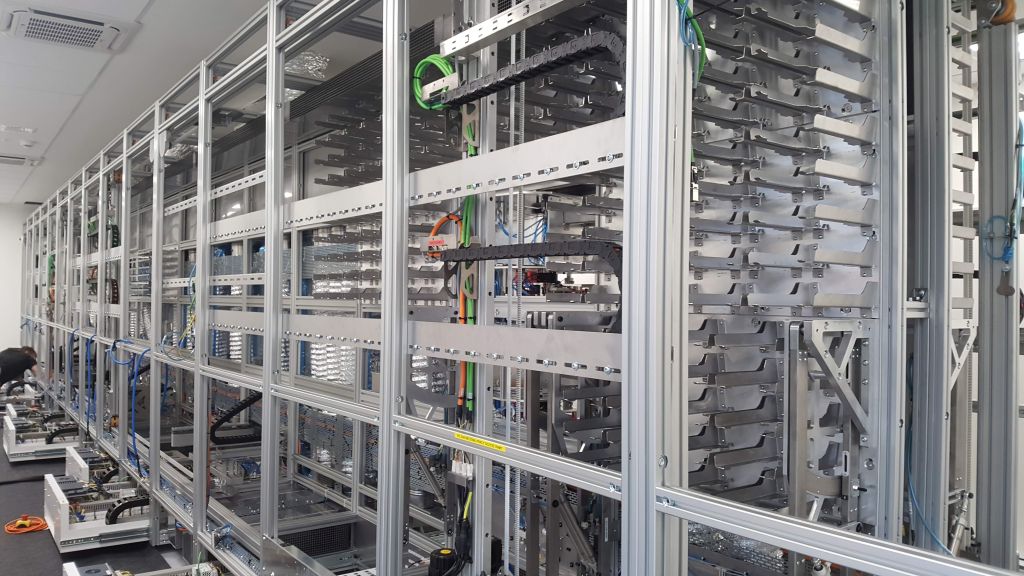
Intensive work is underway at the Provincial Hospital named after L. Rydygier in Toruń, concerning the installation of an automated pharmacy system. This project requires work across a wide range of areas, from construction to electrical power supply (including a UPS for the system), as well as the installation of systems necessary for the automated pharmacy robot to function correctly and for the safe storage of pharmaceuticals. This includes ventilation and air conditioning, compressed air, a condensate drainage system, and more. Only once these preparations are complete can the pharmacy robot itself be installed. Currently, the project is at the stage of installation and programming.
The UnitDoseOne system features a modular design, allowing it to be configured and expanded to meet the specific needs of a hospital. This applies equally to the Regional Hospital Complex. The automated pharmacy comprises 10 modules for storing single-dose medications – these are packaged and stored in individual sachets, each clearly labelled with a description and barcode – 10 modules for medication packaging, and 10 modules for storing larger quantities of medication, including full packages, with 2 of these modules being refrigerated. The entire system spans over 14 metres in length, 2 metres in width, and nearly 3 metres in height. In addition, it includes: 4 dispensing points for individual patient medication packages, 6 workstations (computer systems for operating the system, complete with software), and 6 barcode scanners, designed for pharmacy staff. The system is further complemented by 5 ward pharmacies with access control, and 20 trolleys for transporting medication to the wards.
What is the primary objective of the automated pharmacy? What benefits does it offer pharmacists and nurses?
Previously, individual departments would place orders for medication. Full packages were transported from the pharmacy to ward pharmacies, where nurses would divide them into single doses, dispensing them in cups at specific times. Each medication was manually recorded in patient documentation, which was a time-consuming process. Now, thanks to the automation of this process, valuable time can be saved and dedicated to providing better patient care.
At the Bielański Hospital, the manufacturer assures, The process will begin with an electronic prescription. All prescriptions will be analysed by the system and verified by pharmacists. Once approved, the system will check if all medications are in stock and if there is a need to replenish inventory. The most significant change will be that each medication will become a separate accounting unit – each will have its own packaging and a 2D barcode, allowing for complete identification.
Medications in single-dose form will be prepared by a pharmacy robot, which will fully automatically prepare not only the individual doses themselves, but also complete sets ready for administration to patients.
Such a system will be transported to the relevant department (initially using trolleys, and eventually through a pneumatic mail system being implemented within the hospital – subject to the specific characteristics of the medication – ed.The nurse, scanning the medication package barcode and the patient’s wristband, will verify and confirm the administration of the medication. All of this information will be automatically transmitted to the IT system.
This will significantly ease the workload for nurses, who will no longer need to manually prepare dosages and record what and when medication has been administered to patients. It also removes the requirement for nurses to manually verify dosages and medications at the patient’s bedside. Meanwhile, pharmacists will be able to more easily and quickly check prescriptions, and also consult with doctors regarding any necessary changes, particularly when there are potentially adverse interactions between prescribed medications. It should be noted that the UnitDoseOne system is integrated with the hospital’s information system (HIS – Hospital Information System), allowing doctors to access up-to-date information, such as medication availability, and to review a patient’s previous medication history.
The UnitDOseOne system also enhances patient safety. Whether it’s individual medications or pre-packaged sets, everything is clearly labelled with appropriate codes and placed in containers assigned to each patient. Scanning the codes on the patient’s wristband and the medication dose bag allows for the detection of any discrepancies. The journey of each individual dose is tracked by the system from the moment the medication enters the pharmacy, minimising the possibility of error. Furthermore, as medications are stored individually in sachets, there is no risk of cross-contamination. Any pharmaceuticals originating from recalled batches are automatically rejected. The system alerts the operator if a medication is nearing its expiry date or is running low. It also notifies the operator if a medication has been damaged during packaging; in such cases, the medication is rejected. The system also allows for the return of unused doses back to the pharmacy stock. It is worth noting that the automated system packages not only tablets from various containers (including blister packs) of different sizes, but also ampoules, vials, sachets, suppositories, and syringes.
In an adjacent room, a pneumatic mail station has been installed to facilitate the delivery of medications that do not require special handling. Those that are sensitive to shocks or temperature will continue to be transported to the ward in specially designed trolleys, ensuring optimal transport conditions.
The UnitDoseOne automated pharmacy system is a comprehensive solution that will quickly become an integral part of hospital operations, allowing medical staff to save valuable time and eliminating the risk of medication errors.